
 ENG
ENG
 English
 русский
 Español
In the field of heavy-duty machinery engineering, selecting the correct Industrial Travel Drive (also known as a final drive or track drive) is a critical decision that determines equipment reliability, maneuverability, and service life. Whether you are designing a 50-ton crawler excavator, a massive harbor crane, or a subterranean mining drill, the travel drive is the core component that translates hydraulic or electric energy into the massive torque required to overcome immense inertia.
1. Calculating Required Output Torque and Load Capacity
The first and most vital step in the selection process is the precise calculation of the Output Torque required under the most grueling operating conditions. In heavy-duty applications, the drive must not only overcome rolling resistance but also provide a massive initial burst of power to start the machine from a standstill.
Deep Evaluation of Static and Dynamic Loads
An industrial travel drive is usually mounted directly to the track sprocket or drive wheel, meaning it acts as a structural component supporting a portion of the machine’s weight.
- Radial and Axial Loads: You must calculate the maximum radial load the drive bearings can sustain to ensure the housing does not deform when operating on uneven terrain.
- Peak Torque: Selection must account for acceleration, counter-rotation (steering in place), and instantaneous shock loads when hitting obstacles. Generally, the peak torque should be 1.5 to 2 times the normal operating torque.
Gradeability and Safety Factor Calculation
In heavy industrial environments, a Safety Factor is not a luxury—it is a necessity.
- Incline Capability: Torque requirements must be calculated based on the maximum specified gradeability (e.g., a 35% slope). This requires a deep understanding of the Planetary Gearbox reduction ratio ($i$) and mechanical efficiency ($\eta$).
- Service Factor: For high-cycle operations or environments with significant shock loads (such as quarries), we recommend a service factor of at least 1.5 to 2.0 to prevent gear teeth from shearing under sudden stress.
2. Choosing Between Hydraulic and Electric Power Systems
The power input method defines the control logic and energy efficiency of the entire machine. While hydraulic drives have dominated the market for decades, electric travel drives are emerging as a major industrial trend in 2026 due to the push for automation.
Hydraulic Travel Drives: Symbols of Durability and Power Density
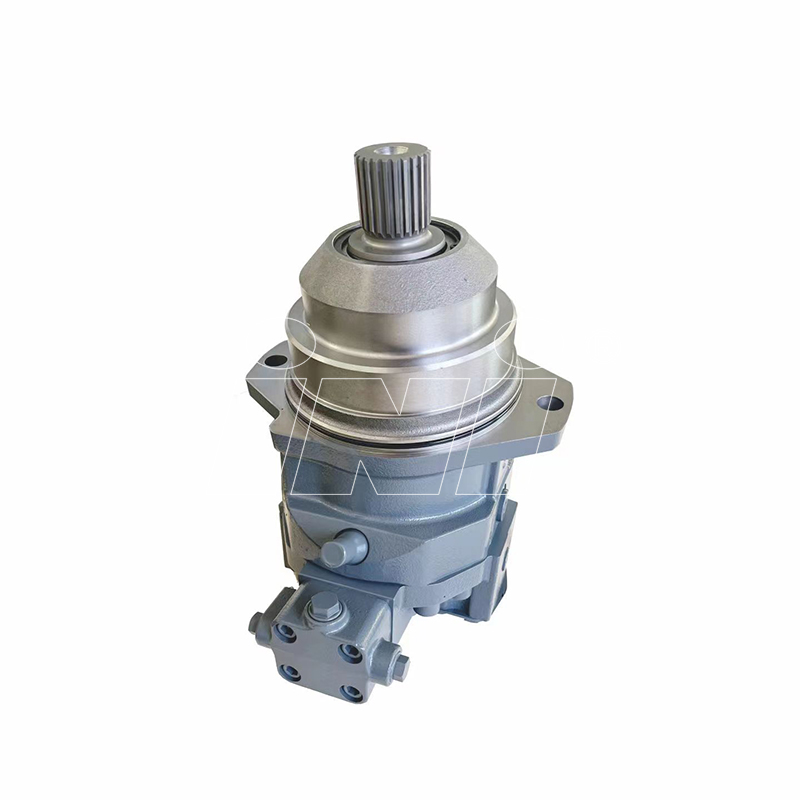
Hydraulic drives are favored for their incredible power density. They typically integrate high-performance piston motors (operating at pressures up to 350-450 bar) and perform stably in the harshest environments.
- Core Advantages: Exceptional starting torque and infinitely variable speed control. Their compact structure allows for easy integration into existing mobile hydraulic circuits.
- Best For: Construction machinery, forestry equipment, and any heavy-duty chassis operating in muddy or wet conditions.
Electric Travel Drives: Precision Control and the Automated Future
With the global push for industrial electrification, electric drives are showing immense potential in mining automation and port logistics.
- Precision Positioning: Electric drives allow for seamless integration of encoders, enabling centimeter-level positioning accuracy—ideal for Autonomous Navigation Systems.
- Energy Efficiency: Compared to hydraulics, electric drives eliminate heat loss caused by fluid friction and are easier to maintain.
- Best For: Automated Guided Vehicles (AGVs), zero-emission mining rigs, and port gantry cranes.
3. Evaluating Gearbox Configuration and Sealing Integrity
Industrial travel drives are typically located in “danger zones”—close to mud, dust, debris, and moisture. The internal precision of the gearbox and the integrity of its external seals determine the maintenance cycle of the equipment.
Multi-Stage Planetary Gear Structures
To achieve the massive reduction ratios required for heavy loads (typically ranging from 1:60 to 1:300), a multi-stage planetary configuration is essential.
- Load Distribution: Planetary gears distribute torque across multiple planet wheels. This allows the drive to output higher torque in a more compact volume compared to traditional parallel-shaft gears.
- Heat Dissipation: Heavy-duty, long-distance travel generates significant heat. Ensure the gearbox housing has sufficient surface area or integrated cooling paths to maintain the performance of the lubricant.
Mechanical Face Seals (Duo-Cone Seals)
For a truly “Industrial Grade” drive, it must be equipped with Mechanical Face Seals, often referred to as floating or lifetime seals.
- Contamination Prevention: These seals consist of two precision-lapped metal rings and two rubber torics. They are designed to lock lubricant inside while completely blocking abrasive contaminants like sand, dust, and seawater.
- Longevity: In dredging or open-pit mining, these seals allow the drive to operate while partially submerged or in “cloud-of-dust” conditions for extended periods without internal contamination.
Industrial Travel Drive Selection Comparison
| Technical Feature | Light/Medium Duty Drive | Heavy-Duty Industrial Drive |
|---|---|---|
| Reduction Stages | 1 or 2 Planetary Stages | 3 or more Planetary Stages |
| Typical Gear Ratio | $1:10$ to $1:50$ | $1:60$ to $1:300+$ |
| Sealing Type | Standard Lip Seals | Mechanical Face Seals (Duo-Cone) |
| Braking System | External or None | Integrated Multi-Disk Parking Brake |
| Bearing Life ($L_{10}$) | 5,000 Hours | 15,000+ Hours |
FAQ: Frequently Asked Questions
Q: Can I replace a hydraulic travel drive with an electric one on an existing machine?
A: It is technically possible but requires a major overhaul of the power system and control software. The key is ensuring the electric motor’s “Stall Torque” matches the starting torque of the hydraulic motor it is replacing, while also reconfiguring the battery or cable power supply.
Q: How often should the gear oil be changed in a heavy-duty drive?
A: For new units, an initial oil change is recommended after the first 50-100 hours of “break-in.” Subsequently, changes are typically required every 1,000 to 2,000 hours, depending on operating intensity and ambient temperature.
Q: What is the leading cause of travel drive failure in the field?
A: Contamination due to seal failure. Once abrasive particles enter the planetary stages, the gears wear down rapidly. Other major causes include neglecting oil levels and prolonged operation above the rated peak torque.
References & Industry Standards
- ISO 6336: Calculation of load capacity of spur and helical gears (Standard for planetary gear strength).
- DIN 3990: Standard for calculation of cylindrical gear load capacity.
- AGMA 2001-D04: Fundamental Rating Factors and Calculation Methods for Involute Spur and Helical Gear Teeth.

 English
 русский
 Español
 TOP
TOP